


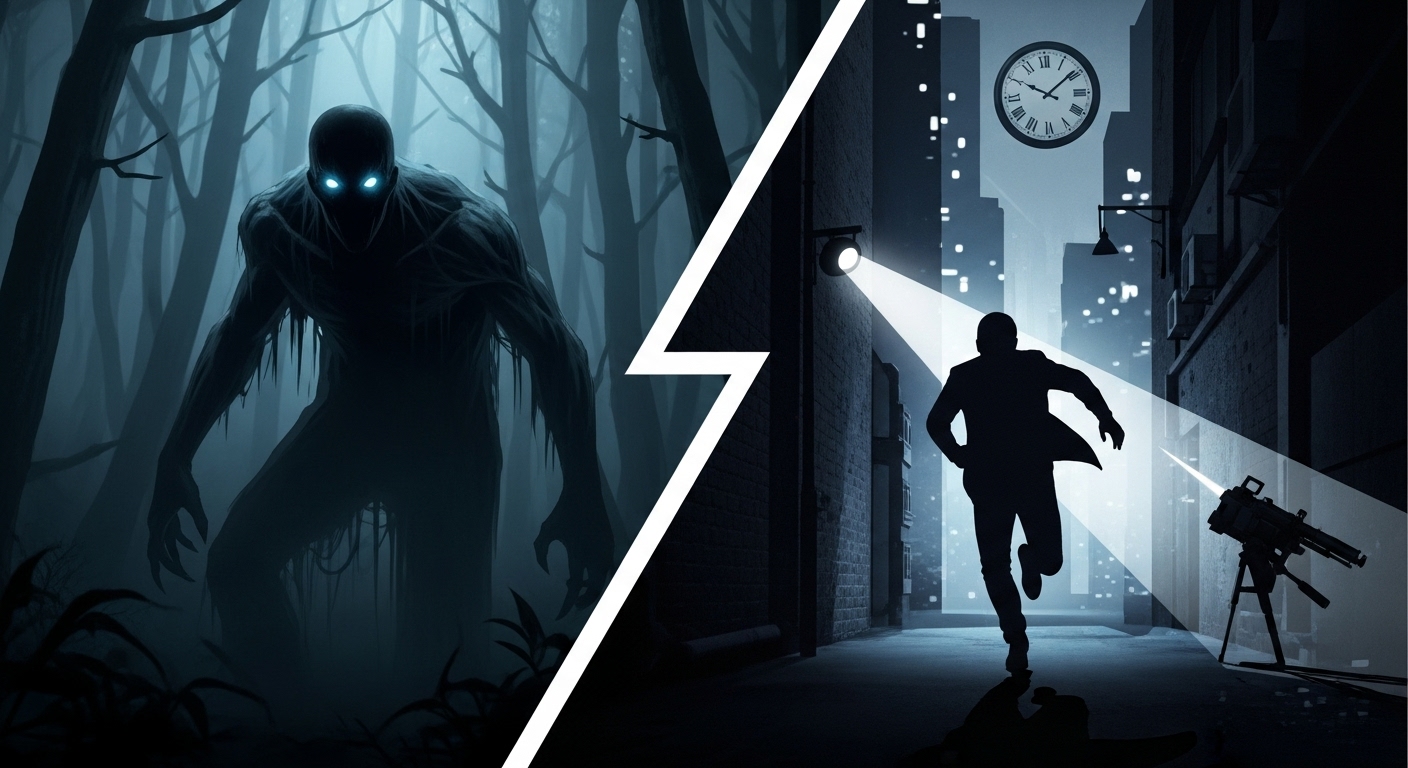
Are you sitting on the couch, watching a movie, and wondering, “Is this a horror movie, or is it a thriller?” You are not alone. It’s easy to confuse these two genres. They are close cousins; they both make your heart race and glue you to the edge of your seat. However, if you are asking what is the difference between a horror and a thriller, you need to look at their core goals. They aim for different feelings and use totally different tricks to get a reaction from you.
As an expert in writing, I will give you a clear, easy-to-use set of rules. We will break down the two genres based on their goals, their enemies, and how they tell a story. By the time you finish reading, you will know exactly why one movie leaves you feeling scared and disgusted, while the other leaves you feeling anxious and excited.
Let’s dive in and learn the real difference between a horror story and a suspense thriller.
The Core Difference: Intent and Emotion
The easiest way to tell the two genres apart is by asking a simple question: What is the story trying to make me feel?
The goal of the story dictates everything else, from the lighting to the ending.
Horror: The Goal is Fear and Shock (Visceral)
Horror stories want to make you feel fear and dread. The reaction is visceral—it hits you in your gut.
- Primary Emotion: Fear, terror, and revulsion.
- Method: Horror uses shock (the sudden jump scare) and visceral imagery (gore, graphic violence, monsters) to provoke a primal, physical reaction. It is about confronting the things we fear the most: death, pain, and the supernatural unknown.
- The Feeling: When you watch a horror film, you cringe, you cover your eyes, and you feel unsafe. Horror often works because it shows you something disgusting or unnatural. You feel bad for the victim.
- Focus: The focus is on the victim’s experience and the impact of the evil force.
Thriller: The Goal is Suspense and Excitement (Cerebral)
Thriller stories want to make you feel suspense and excitement. The reaction is cerebral; it engages your mind and makes you think.
- Primary Emotion: Anticipation, anxiety, and intellectual stimulation.
- Method: Thrillers use suspense (the slow build-up of tension) and mystery (clues, puzzles, plot twists) to create an adrenaline rush. It is about a high-stakes problem that needs solving.
- The Feeling: When you watch a thriller, you hold your breath, you try to solve the puzzle, and you feel excited. The tension comes from what might happen. You feel invested in the chase.
- Focus: The focus is on the protagonist’s struggle to solve a crisis before a deadline.

Psychological Thriller Novel
Serious Consequences
By David Stewart
Aggie Upton wakes from a coma to find her home destroyed and her husband in federal prison. As she searches for answers, she uncovers dark truths that threaten her safety, her sanity, and everything she thought she knew.
The Antagonist: Who is the Enemy?
The type of enemy in the story reveals the genre’s true nature. The villain in a thriller is usually an issue of human failure. The villain in a horror is often an issue of nature failing.
Horror’s Monster: Often Unstoppable and Unnatural
In horror, the enemy is often something that cannot be reasoned with, stopped by police, or explained by science.
- Source of Evil: The antagonist represents a force that is fundamentally wrong with the world. This is why horror frequently uses the supernatural: ghosts, demons, zombies, or masked killers who do not follow the rules of life or death.
- Protagonist’s Control: The main characters have very little control. Their goal is simple: survive, escape, or die trying. The story makes you feel powerless. Even when the hero wins, the evil usually lingers, suggesting the fight is never truly over.
- Example Antagonists: Jason Voorhees, the Demon in The Exorcist, the entity in It Follows.
Thriller’s Adversary: Human, Logical, and Solvable
In a thriller, the enemy is usually a person or a secret that can be defeated by smart thinking or action.
- Source of Evil: The antagonist is usually a human threat—a spy, a serial killer, a corrupt politician, or a ticking time bomb. The evil is a clear aberration (a bad spot) inside a normal, functioning world.
- Protagonist’s Control: The main characters have high control. They are often police officers, detectives, spies, or clever private citizens. Their goal is complex: solve the puzzle, catch the killer, or stop the event. The story gives you a feeling of involvement. The problem can be solved, and the world can return to normal.
- Example Antagonists: Hannibal Lecter, the Zodiac Killer, a rogue government agent.
Pacing and Tension: Dread vs. The Ticking Clock
The way a story controls its speed, or pacing, is a massive genre tell.
Pacing in Horror: Slow Burn to Shock
Horror uses tension to create dread. The slow, creeping feeling that something awful is coming.
- Tension Style: It often uses a slow, quiet build-up—the creepy music, the long hallway, the slow camera push, leading to a sudden, loud shock (a jump scare or a graphic reveal).
- Resolution of Tension: Horror frequently releases and then rebuilds tension. A scare happens, you breathe a sigh of relief, but you know another one is just minutes away. The goal is to keep you unbalanced.
- Filmmaking Note: Sound design is key. The silence is often as scary as the scream.
Pacing in Thriller: Constant Escalation
Thrillers use tension to create anticipation. It is a tight, constant feeling, like a rubber band being pulled tighter and tighter.
- Tension Style: Thrillers rely on a ticking clock. There is a deadline—the bomb will go off, the killer will strike again, and the truth must be exposed by morning. The plot moves fast, using car chases, interrogations, and unexpected plot twists.
- Resolution of Tension: The suspense builds for the entire story, only releasing at the very end in a huge climax when the puzzle is solved or the main conflict is over. This provides intellectual satisfaction.
- Filmmaking Note: Intricate plots and high-stakes scenarios drive the action.
The Role of the World and Protagonist Control
This is a deeper difference that speaks to the meaning behind each genre.
Horror: Society Fails You
In a horror story, the world itself is a hostile, terrifying place. The normal rules of society do not apply.
- Worldview: The police, the government, and the laws of science are powerless against the threat. You cannot call 911 to report a ghost or a werewolf. When the main character seeks help, the systems we trust, the police, the church, and a scientist usually fail them completely.
- Thematically, Horror suggests that human beings are small and helpless against the vast, dark forces of the universe. It is a story of powerlessness.
Thriller: The System Can Be Fixed
In a thriller story, the systems of society are mostly functional, but they have been corrupted or bypassed by a human agent.
- Worldview: The threat is an aberration in the system. The hero’s goal is to use the system, detective work, forensic science, and military tactics to restore order. The police can stop the killer once they find the right clue. The problem is complicated, but it is not supernatural.
- Thematically, Thrillers suggest that human intelligence and resourcefulness can defeat evil. It is a story of competence and solving a problem.
Decoding the Subgenres: When Genres Collide
The biggest confusion comes from hybrid genres. Many stories fall under the umbrella of “horror-thriller.” To figure out what a story really is, look at the kind of fear it chooses.
Psychological Thriller vs. Psychological Horror
- Psychological Thriller: Focuses on mental suspense. The main character might be paranoid, the plot involves a mystery where the truth is hidden, or the audience questions the reality of what they are seeing. The source of the fear is usually human (a gaslighter, a manipulating spouse, a corrupt mind). Example: Gone Girl, Shutter Island.
- Psychological Horror: Focuses on mental dread. The story explores themes of madness, isolation, or obsession, often with supernatural elements as a metaphor for the mental breakdown. The fear is visceral, even if it happens inside the mind. Example: Hereditary, The Babadook.
Supernatural Thriller vs. Supernatural Horror
- Supernatural Thriller: Features a ghost or a mystical element, but the plot revolves around solving the mystery of the entity to make it stop. The action is driven by a detective, a priest, or an investigator figuring out the rules. Example: The Sixth Sense (The dead are not an active threat; they are a mystery to be solved).
- Supernatural Horror: Features a ghost or demon, and the plot revolves around surviving its relentless, physical, or spiritual attacks. The entity’s identity is not as important as its ability to hurt the characters. Example: The Conjuring, Insidious.
How to Classify a Hybrid: Focus on the Climax
Stories like The Silence of the Lambs are often called horror-thrillers. How do you choose?
- The Thriller Element: The core plot is a police procedural (FBI trainee Clarice Starling must solve a crime). This is the suspense and the chase.
- The Horror Element: The antagonist, Hannibal Lecter, is a monster. He represents a grotesque, unnatural evil that is purely visceral and deeply unsettling. The film uses body horror and extreme darkness.
The Rule: A hybrid is classified by its primary engine and its ultimate emotional goal. The Silence of the Lambs uses the thriller structure (the mystery/chase) but uses horror elements (Lecter’s cannibalism, grotesque murder scenes) to elevate the fear. It is a thriller that is horrifying.
Frequently Asked Questions (FAQs)
1. Is a “jump scare” a horror or thriller technique?
A jump scare is a classic horror technique. It relies on shock, a sudden, loud event designed to make you jump. Thrillers create tension through sustained suspense that builds slowly over time, not usually through sudden shock. If a thriller uses a jump scare, it is borrowing a horror element.
2. Can a story be both horror and a thriller?
Yes. The genres are best viewed as existing on a spectrum, or a sliding scale. A film is a pure thriller if its focus is purely on suspense and solving a logical human crisis (like a spy movie). It is pure horror if its focus is purely on dread and confronting an unstoppable evil (like a slasher film). Many successful, boundary-pushing stories, like Alien or Get Out, pull from both to maximize the audience reaction.
3. Which genre relies more on gore and graphic violence?
Horror relies more heavily on gore and graphic violence. This is because horror seeks to evoke revulsion and shock—visceral, physical reactions. While thrillers can be violent (especially crime thrillers), the violence is often implied, quick, or used to raise the stakes of the plot, not to make the viewer feel sickened.
4. How does the ending differ?
In a thriller, the ending usually provides resolution and intellectual satisfaction. The puzzle is solved, the killer is caught, and the threat ends. In horror, the ending often leaves a sense of unresolved dread. The evil may be temporarily defeated, but a final shot suggests the monster is not truly dead, or the haunting continues. Horror avoids satisfaction to preserve the feeling of powerlessness.
5. Which genre is better for character development?
Generally, thrillers focus more on detailed character development. The protagonist needs complex motivations, sharp intelligence, and detailed flaws to make the solving of the puzzle meaningful. In horror, the characters often act more like archetypes (the skeptic, the final girl, the wise elder) whose main purpose is to react to the fear and drive the narrative of survival.
Conclusion: Understanding the Story’s Engine
To perfectly understand the difference between a horror story and a thriller, remember this simple idea: Horror is about confronting fear; Thriller is about managing suspense.
- Horror wants you to feel bad (fear, dread).
- Thriller wants you to feel excited (anticipation, anxiety).
One story tells you, “The monster is here, and you are going to die.” The other story tells you, “The clock is ticking, and you must figure out who the monster is before it’s too late.”
Next time you choose a movie or a book, look beyond the scary poster. Ask yourself: Is this story giving me clues to solve, or is it setting the stage for inevitable, terrifying chaos? Once you know the intent, you know the genre.
What is your favorite genre to write or watch? Share your thoughts below! Are you a fan of slow-burn psychological horror, or do you prefer a fast-paced espionage thriller? Tell us your favorite example of a true horror-thriller hybrid in the comments.





0 Comments